
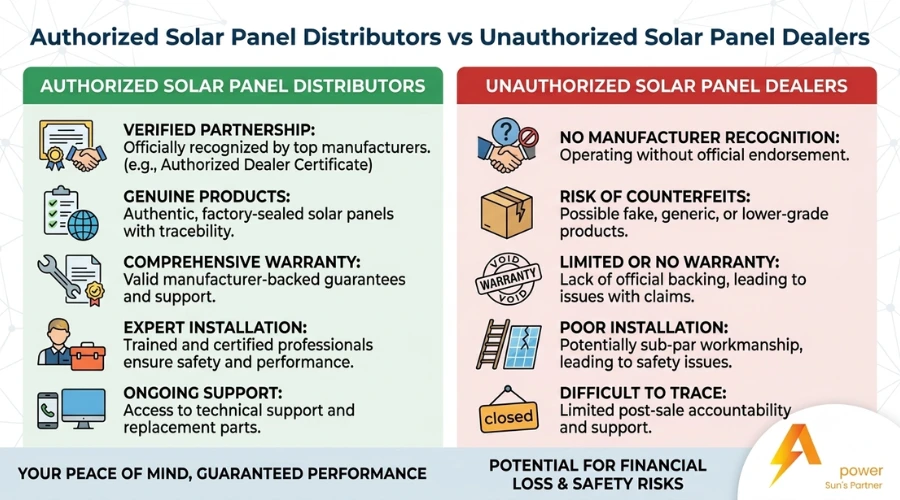
Thousands of people across India are making the switch to solar energy every month. And with that surge in demand has come an equally fast-growing market of sellers some genuinely certified, some not. If you’ve ever wondered why two quotes for “the same panel” can vary so wildly in price and warranty terms, the answer almost always traces back to whether you’re dealing with an authorized distributor or an unauthorized one.
This piece breaks down what actually distinguishes these two categories, what risks come with each, and how to protect yourself before signing a purchase order.
What Makes a Solar Panel Distributor “Authorized”?
An authorized solar panel distributor in India has a formal, documented agreement with the panel manufacturer. This isn’t just a handshake deal it involves brand certification, territory rights, training requirements, and accountability structures.
When a company like Renewsys, Sunways, Enphase appoints an authorized distributor, that entity goes through a vetting process. They must meet minimum infrastructure standards, keep stock of genuine products, provide after-sales support, and uphold the brand’s quality benchmarks. In return, they gain access to original equipment, official warranties, and replacement support directly from the manufacturer.
The “authorized” label also typically means the distributor is registered under India’s GST framework, issues proper invoices, and is accountable to a grievance redressal mechanism. If a panel fails or underperforms, the authorized channel has an actual chain of accountability back to the manufacturer.
What Does an “Unauthorized” Solar Panel Dealer Actually Sell?
This is where things get complicated and sometimes deceptive.
An unauthorized solar panel dealer in India may sell products that look identical to branded panels on the surface. The wattage labels match. The branding looks right. But what’s inside the panel the cell quality, the encapsulate material, the frame alloy may be entirely different from the original spec.
Some unauthorized dealers source panels from grey markets, rejected factory batches, or counterfeit assemblers. Others import panels without proper BIS (Bureau of Indian Standards) certification, which is now mandatory under the ALMM (Approved List of Models and Manufacturers) policy for grid-connected solar projects.
The pricing usually looks attractive. That’s intentional. A 10–15% lower upfront cost is designed to make you skip the due diligence.
The ALMM Policy and Why It Matters
Since 2021, the Indian government has mandated that solar modules used in government and grid-connected projects must come from manufacturers listed under the ALMM. Unauthorized dealers often sell modules from non-ALMM manufacturers meaning if you’re a developer, EPC contractor, or even a C&I buyer applying for net metering, these panels can fail regulatory scrutiny and block your subsidy claims.
This isn’t a technicality. Developers have had projects held up because panels weren’t traceable to a listed manufacturer. Authorized solar panel distributors in India carry products that are ALMM-compliant by default, because their supply chain is tied directly to certified manufacturers.
Performance, Warranty, and What Happens After Year One
The performance gap between genuine and counterfeit panels often doesn’t show up immediately. In the first few months, both may produce similar output. The divergence starts around year two or three and by year five, panels from unauthorized sources can degrade significantly faster than their claimed specifications.
Genuine Tier-1 solar panels are typically backed by a 10-year product warranty and a 25-year linear performance warranty. These warranties are only enforceable if you bought through an authorized channel. If your panel was sourced through an unauthorized dealer, the manufacturer has no record of your purchase and no obligation to honor a claim.
One thing that often surprises buyers: even if the panel itself is a genuine product that somehow passed through an unauthorized dealer, the warranty becomes void the moment the original manufacturer discovers it wasn’t sold through a certified channel. So the “real panel, just cheaper” argument collapses at the warranty level.
How to Identify a Genuine Solar Panel Dealer in India
Verifying authorization doesn’t require any specialized knowledge it just takes a few minutes.
Most major solar panel brands in India maintain publicly accessible dealer locator tools on their websites. If a seller claims to be an authorized dealer for sun’s or Renewsys Solar, you can cross-check their name and location on the brand’s official portal. If they don’t appear there, that’s a red flag regardless of what they tell you.
Ask for the manufacturer’s appointment letter or dealership certificate. Authorized dealers carry these documents and produce them without hesitation. A legitimate solar panel dealer in India who is certified will also provide an invoice that includes the panel’s serial number allowing you to register the product for warranty purposes directly with the manufacturer.
Also check for MNRE (Ministry of New and Renewable Energy) registered vendor status, especially for projects that attract government subsidies. This is an additional layer of verification that unauthorized dealers cannot meet.
The Price Difference Explained
It’s worth understanding why authorized distributors price higher. Part of it is the supply chain integrity they’re buying direct from certified manufacturers at negotiated volumes and meeting quality audits. Part of it is the overhead of maintaining service infrastructure. And part of it is that they carry the warranty risk, which means they price for the possibility of replacement.
An unauthorized dealer who cannot offer genuine warranty support has none of those costs which is exactly why their pricing looks tempting and why their accountability disappears after the sale.
The Real Cost of Choosing Wrong
A rooftop solar installation in India for a typical home costs anywhere between ₹1.5 lakh and ₹4 lakh, depending on capacity and location. Commercial and industrial setups run into the crores. These are long-horizon investments meant to generate returns over 20–25 years.
Buying panels through an unauthorized channel to save 10% upfront can mean facing replacement costs in year five or six when panels degrade ahead of schedule. It can mean losing subsidy eligibility under PM Surya Ghar or state government schemes. It can mean no recourse when a panel develops a hotspot, micro-crack, or delamination issue.
The math on “saving money” by going unauthorized simply doesn’t hold when you model it over the actual lifespan of the system. Authorized solar panel distributors in India offer something that an unauthorized dealer structurally cannot: a documented, enforceable promise of performance.
Before You Buy: A Simple Checklist
Verify the dealer’s name on the brand’s official distributor list. Request the dealership certificate and confirm its validity period some authorizations expire and dealers don’t always update their customers. Ask for an invoice format that includes panel serial numbers, because without that serial number, you cannot register for manufacturer warranty support.
Check ALMM compliance of the specific model being quoted. The ALMM list is publicly available on the MNRE website and is updated periodically, so a model that was compliant six months ago may have been removed. For government-linked projects or any system applying for PM Surya Ghar or state subsidy, confirm MNRE registration of the installer and the equipment source.
If any of these requests are met with resistance or vague answers that response tells you everything you need to know. A genuinely authorized solar panel dealer in India will not hesitate to share documentation, because their entire business model depends on that certification remaining intact.
The solar industry in India is maturing fast. Regulatory frameworks are tightening, and buyers are becoming more informed. The gap between authorized and unauthorized is getting harder for bad actors to paper over as digital verification tools improve and government audits of subsidized projects become more rigorous.
Unauthorized dealers still exist because there’s still a market for them a buyer who prioritizes the lowest quote above all other factors. But that market is shrinking as the consequences of non-compliance and premature hardware failure become harder to absorb, especially for commercial and industrial buyers whose systems run into significant capital outlays.
The question to ask before signing anything isn’t just “is this price right?” It’s “will this seller still be reachable in three years when I need them to be?”
Making a solar investment is a long-term commitment. The channel you buy through is part of that commitment, and the difference between an authorized distributor and an unauthorized one is ultimately the difference between a backed promise and an empty one.